How to Choose Maryland Roofing Contractors in 2026
A 2026 guide from a 30-year Maryland roofer — MHIC #85703, CertainTeed ShingleMaster certified. Every check below is free and takes minutes.
Manufacturer certifications — the credentials this guide teaches you to verify



Maryland roofing contractors are not hard to find. After a good storm rolls through Anne Arundel County, they find you — knocking on doors, leaving flyers, promising a free roof through your insurance. We’re headquartered right here in Anne Arundel County ourselves — our Millersville roofing contractor page covers our own home turf. The hard part isn’t finding a roofer. It’s knowing which one will still answer the phone in five years.
We’ve spent more than 30 years roofing Maryland homes through our roofing services, and we’ve repaired plenty of work sold by contractors who vanished. So instead of telling you to hire us, this guide teaches you how to vet any roofing company in Maryland, including ours. Every check below is free, takes minutes, and filters out most of the risk before you sign anything.
How to pick a good roofer in Maryland
Here’s the short version. The rest of this guide walks through each step in detail.
- Verify the MHIC license is active and matches the business name.
- Confirm general liability insurance and workers’ compensation coverage.
- Check manufacturer certifications and what warranties they unlock.
- Read recent reviews from your county, not just the overall star rating.
- Insist on a detailed, line-item written estimate.
- Compare at least three quotes on scope, not just price.
A contractor who passes all six checks is very unlikely to let you down. A contractor who fails even one deserves a harder look.
Verify the MHIC license before anything else
Every home improvement contractor in Maryland is required to hold a license from the Maryland Home Improvement Commission (MHIC). Not “should have.” Required, by law.
Verification takes two minutes. Search the company name or license number in the Maryland Department of Labor’s public license lookup and check three things: the license is active, the business name matches the name on your estimate, and the license covers home improvement work. If a salesperson hesitates when you ask for their MHIC number, that hesitation is your answer. A legitimate contractor will rattle it off — ours is MHIC #85703, and we’d rather you check it than take our word for it.
The license matters for a practical reason beyond legitimacy: Maryland’s Home Improvement Guaranty Fund can compensate homeowners for actual losses caused by licensed contractors. Hire unlicensed, and that protection disappears.
Confirm insurance and workers’ compensation
Ask for two certificates: general liability insurance and workers’ compensation. Then do the step almost nobody does: call the insurance company and confirm both policies are current.
This isn’t paranoia. If an uninsured worker falls off your roof, the claim can land on your homeowner’s policy. If an uninsured crew drops a ladder through your bay window, you’re negotiating with whoever picks up the phone. Certificates are easy to request and free to verify, and a contractor who’s properly covered will hand them over without friction.
Check manufacturer certifications and warranties
Shingle manufacturers like CertainTeed, GAF, and Owens Corning certify a small share of contractors who complete their training and maintain a track record of correct installs. Credentials like CertainTeed ShingleMaster and GAF factory certification matter for two reasons.
First, they’re independent proof of competence. A manufacturer puts its warranty money behind that contractor’s work, and it audits installs to keep it that way. Second, certified installers can register enhanced warranties that uncertified ones simply can’t offer, sometimes extending coverage on both materials and workmanship by decades.
Understand the difference between the two warranties you’ll hear about. The manufacturer warranty covers the shingles themselves — defects, premature failure, granule loss. The workmanship warranty covers the installation, and it’s only as good as the company standing behind it. A 50-year shingle installed wrong fails in five, and the manufacturer won’t cover an install error from an uncertified crew. That’s why certification and workmanship terms belong in the same conversation. Ask what certification the contractor holds, which warranty tier your project qualifies for, and whether the workmanship warranty transfers if you sell the house. Then get all three answers in writing.
Red flags: storm chasers and door-knock roofers
Maryland gets real weather, and real weather attracts a predictable wave of out-of-state operators. We’ve re-done enough of their work to know the pattern. Walk away when you see:
- A knock on your door right after a storm from a company you’ve never heard of
- Pressure to sign today to “lock in” a price or an insurance deal
- A request to sign over your insurance claim or pay a large deposit in cash
- No local address, no MHIC number on the truck, the flyer, or the contract
- A quote dramatically lower than every other bid you’ve collected
- “We’ll cover your deductible” offers, which can amount to insurance fraud in Maryland
The pattern usually runs the same way. A crew canvasses a neighborhood the week after a hailstorm, finds “damage” on every roof they inspect, and pushes the homeowner to sign an agreement on the spot so they can “handle everything with the insurance company.” The work, if it happens at all, is fast and thin: new shingles over damaged decking, reused flashing, no permit. By the time the roof leaks, the truck, the phone number, and the company name are gone. We’ve been called in to redo that job more times than we can count, and the homeowner pays for the roof twice.
None of the red flags above automatically means a scam. All of them mean slow down. A roof that needs replacing this month will still need replacing next week, after you’ve run the checks in this guide.
How to compare roofing quotes in Maryland
Three quotes is the practical minimum, but comparing bottom-line numbers tells you almost nothing. Two quotes $4,000 apart may describe two completely different roofs. Make every bidder itemize, then compare line by line:
| Line item | Why it matters |
|---|---|
| Tear-off and disposal | How many layers come off, and who hauls the debris |
| Decking repair | Price per sheet of replaced plywood, agreed before work starts |
| Underlayment and ice/water shield | The waterproofing you never see but always need |
| Flashing | New flashing vs. reusing old — a common corner to cut |
| Shingle brand and line | “Architectural shingles” spans a wide quality range |
| Ventilation | Ridge vents and intake keep the new roof from overheating in summer |
| Warranty terms | Workmanship years and manufacturer tier, in writing |
The cheapest quote usually earns its price somewhere in that table. So does the most expensive one. What you want is the quote that explains itself.
What does a new roof cost in Maryland?
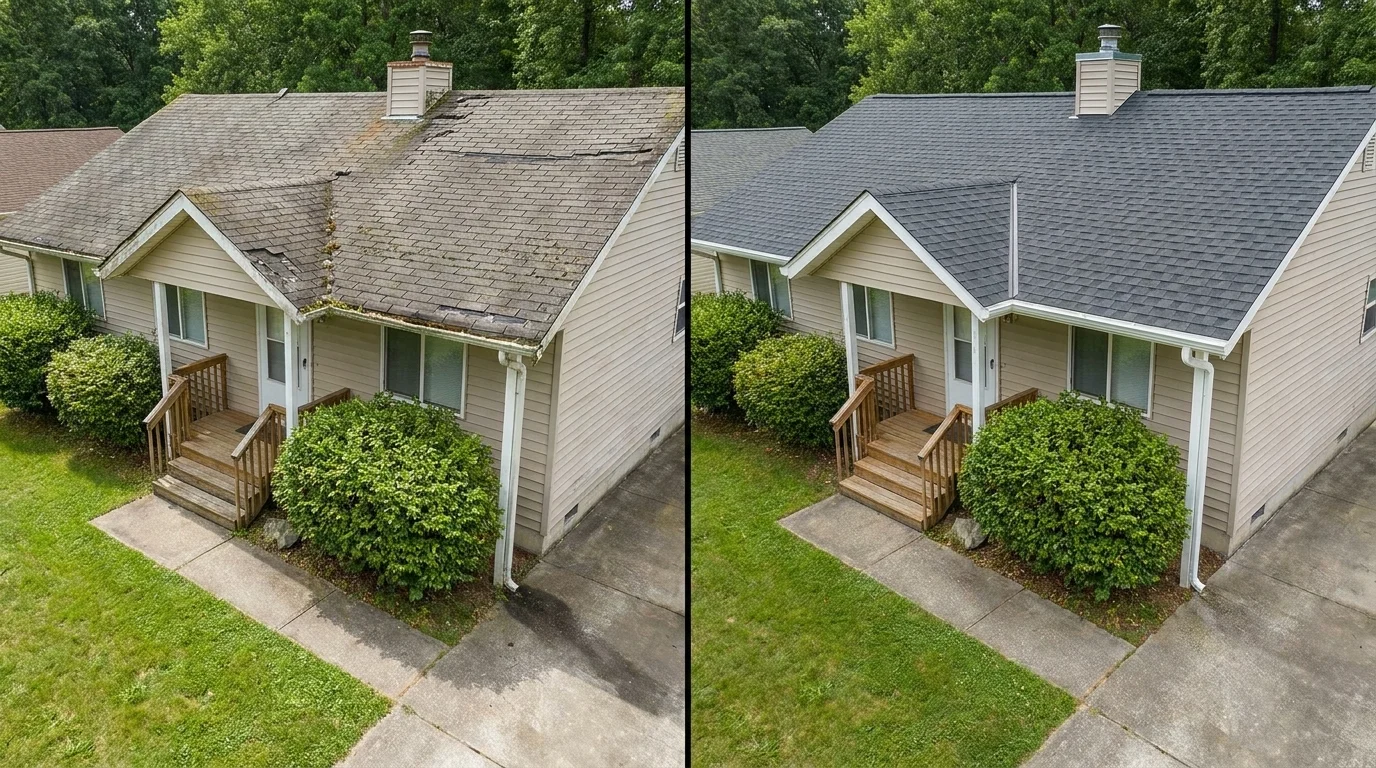
Most Maryland homeowners pay between $8,000 and $25,000 for a full roof replacement. Standard asphalt shingle roofs on typical single-family homes generally land between $8,000 and $15,000, while large homes, steep or complex rooflines, and premium materials like metal or slate push projects toward $25,000 and beyond.
Size, pitch, material choice, decking condition, and the number of old layers to tear off drive most of the variation. Material is the biggest lever: standard architectural shingles sit at the affordable end, designer shingles and cedar shake cost more, and standing seam metal or slate can double a project’s price while doubling or tripling its lifespan. Maryland’s climate complicates the math a little, because a cheaper roof that handles freeze-thaw poorly isn’t cheaper for long.
Be wary of any contractor quoting a precise number without setting foot on your roof, and equally wary of one who won’t put a detailed number in writing after inspecting it. If timing is the obstacle, ask about payment plans — we offer flexible financing options, and most established Maryland contractors have something comparable.
What Maryland roofing contractors handle by region
Maryland packs a surprising range of roofing conditions into a small state, and a good contractor prices and builds for your county’s specific weather.
Central Maryland and Anne Arundel County
Chesapeake-area humidity, summer thunderstorms, and salt air closer to the Bay make ventilation and algae-resistant shingles worth discussing here. Storm damage work is a regular part of the job — our own Annapolis roofing services see wind-lifted shingles after nearly every major system that crosses the Bay.
Baltimore metro and Howard County
Baltimore’s housing stock is its own roofing specialty. City rowhomes carry flat or low-slope roofs that use entirely different systems — EPDM rubber, modified bitumen, TPO — with different failure modes and different maintenance rhythms than shingles. If you own a rowhome, make sure the contractor you’re vetting actually installs flat roofing rather than subbing it out, and ask how they handle Baltimore’s historic-district requirements, which can dictate visible materials.
Out in Howard County, Columbia adds a wrinkle most homeowners don’t see coming: village covenant and architectural committee approvals. Some Columbia villages want exterior changes reviewed, roof color included, before work starts. A contractor who works Columbia regularly will know your village’s process; one who’s never heard of it is about to make your project longer. Much of the county’s housing was built in the 1970s and 80s, which means many roofs are now on their second or third replacement cycle, and old decking is a live question worth pricing before the tear-off.
Montgomery County and the DC suburbs
Dense tree cover around Rockville, Bethesda, and Silver Spring means more debris, more shade-side moss, and more gutter problems than the state average. Mature-neighborhood homes here often carry multiple old shingle layers that add tear-off cost. If you’re in this area, our guide to hiring a roofing contractor in Rockville covers the local specifics.
Frederick and Western Maryland
Frederick County sits in a rougher weather lane: more snow load, more freeze-thaw cycling, and hail that reaches roof-damaging size more often than the coastal counties. Ice-and-water shield coverage and attic insulation matter more out here, and our Frederick roofing services page goes deeper on what Western Maryland roofs need.
Questions to ask before you sign a roofing contract
You’ve verified the license, checked the insurance, and compared quotes. Before you sign, ask these five questions and pay attention to how comfortably they’re answered.
Who is actually on my roof — your employees or a subcontracted crew, and are they covered by your insurance? Subcontracting isn’t automatically bad, but the insurance answer changes completely depending on it.
What happens if you find rotten decking, and what will I pay per sheet? Decking surprises are the most common source of mid-project price jumps. A fair contractor prices them before the tear-off, not after.
Who pulls the permit if my county requires one? Like-for-like shingle replacements often don’t need one in Maryland, but county rules differ, and historic districts have their own. The contractor should know your county’s answer cold — and if a permit is needed, they should be the one pulling it, because whoever pulls the permit owns the inspection.
What does your workmanship warranty cover, for how long, and does it transfer if I sell? And finally: who do I call if something leaks two years from now — a name, not a voicemail box?
A contractor who answers all five without flinching is a contractor who’s answered them before. That’s what you want: someone whose process is boring, predictable, and proven.
Frequently asked questions
Which company is the best for roofing?
No single company is best for every roof. The strongest candidate for your project is the one that passes verification: an active MHIC license, current insurance, manufacturer certifications, recent local reviews, and a detailed written estimate. Any company that clears all five checks is worth considering, and any company that fails one isn’t, no matter how good the sales pitch was.
What is the 25% rule for roofing?
It’s a common industry guideline: if more than a quarter of your roof’s surface needs repair, full replacement is usually the smarter spend. Patching that much area rarely holds up long-term, and in some jurisdictions repairs covering more than 25% of the roof can trigger code requirements that make replacement more practical anyway.
What is the best time of year to replace shingles in Maryland?
Late spring through early fall is ideal, since asphalt shingles need temperatures in the 40s or above to seal properly. Reputable Maryland contractors work year-round, though. Late fall and winter installs can actually work in your favor — schedules open up and some contractors offer off-season pricing.
How do I verify a Maryland roofing contractor’s license?
Search the company name or MHIC number in the Maryland Department of Labor’s public license lookup. Confirm the status is active, the business name matches your estimate, and the license covers home improvement work. Free, and about two minutes. We’d suggest doing it for every contractor you talk to, including us.
Get a free estimate from a Maryland roofing contractor
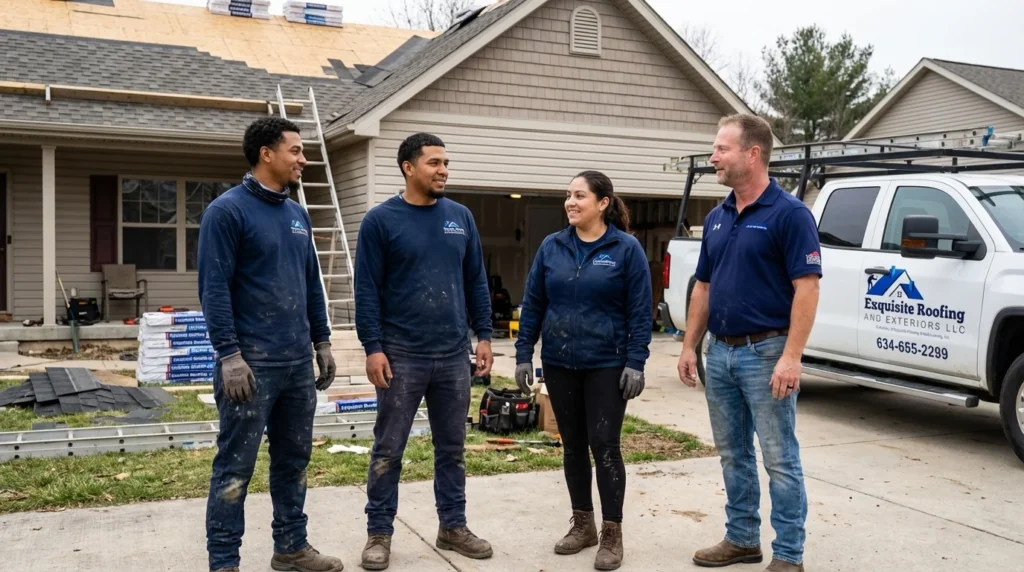
If you’re weighing a repair or replacement anywhere in central Maryland, we’re happy to be one of your three quotes. Exquisite Roofing & Exteriors is a family-owned Maryland roofing company with MHIC license #85703, CertainTeed ShingleMaster certification, and 30+ years in the state. Every inspection and estimate is free with no obligation. Run us through every check in this guide — that’s exactly what it’s for.
Call (443) 233-1119 or request your free estimate online. However you choose, choose a roofer you’ve verified. Your biggest investment deserves that peace of mind.