
Quick answer: most Maryland homes are best served by 6-inch K-style gutters with 3×4-inch downspouts — one size up from the five-inch gutters and 2×3 downspouts builders install by default. The upgrade costs a little more per foot and roughly doubles real-world capacity, which matters here because our summer thunderstorms dump rain faster than a builder-grade gutter system can move it.
We see the water damage from undersized gutters every week: rotted fascia boards, tiger-striped siding, mulch blown out of beds, and basements that take water every July. This gutter sizing guide covers how to calculate the gutter and downspout size your roof actually needs, when the common gutter size (5-inch) is fine, when 6-inch is the right call, and — just as important — when the “gutter problem” you’re chasing is really a roof problem wearing a disguise.
Gutter sizes and styles, quickly
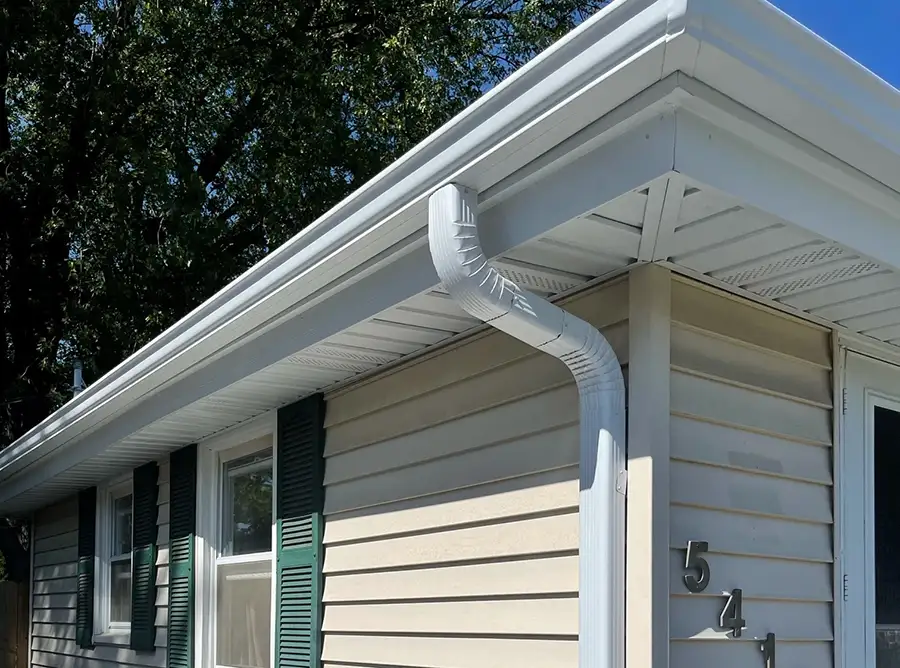
Residential gutters in our area are almost all K-style (the flat-back profile that looks like crown molding from the street), seamless, in aluminum. Half-round gutters show up on historic homes — they look right on older architecture but hold roughly 20–30% less water at the same nominal size. The standard gutter size options in K-style are 5-inch (the builder default) and 6-inch; downspout options are 2×3-inch and 3×4-inch rectangular profiles. Getting the proper gutter installation right is mostly about matching those four numbers to your roof.
| Component | Standard (builder default) | Upsized | Approx. capacity difference |
|---|---|---|---|
| K-style gutter | 5-inch | 6-inch | 6-inch carries roughly 40–50% more water |
| Downspout | 2×3-inch | 3×4-inch | 3×4 moves roughly twice the water and clogs far less |
| Half-round gutter | 5-inch | 6-inch | Holds ~20–30% less than K-style at the same size |
How to calculate the right gutter size
To choose the right gutter size, you need three inputs: the roof area to be drained, the roof pitch, and how hard it rains where you live. This is the same sizing methodology commercial gutter designers use — here it is simplified for a house, in four steps:
- Step 1 — determine the roof area draining to each run. Measure the length and width of each roof plane that feeds a gutter run and multiply them for square footage. A valley that funnels two planes into one short section counts double — that’s exactly where undersized systems spill over first.
- Step 2 — adjust for roof pitch. A steeper roof slope sheds water faster, so sizing tables bump the effective roof area up — roughly 10% extra for a typical 6/12 pitch and more for steep colonials and cape dormers.
- Step 3 — calculate water flow during rainfall. Sizing standards multiply your adjusted roof area by local rainfall intensity — the design rainstorm’s short, violent burst, not the all-day drizzle. This is the input national guides gloss over and the one that matters most in Maryland.
- Step 4 — match gutter capacity and downspout size to that flow. The calculation tells you whether a standard gutter handles the water or the run needs the 6-inch profile, larger downspout size, or more drops.
You don’t need the full calculation for a rule of thumb: a 5-inch K-style rain gutter with adequate downspouts comfortably handles roughly 1,000–1,500 square feet of roof per run in a heavy Maryland downpour; a 6-inch system handles roughly double that. Small rambler with a simple hip roof? Five-inch is genuinely the right size. Two-story colonial with valleys dumping onto a 40-foot length of gutter? That’s 6-inch territory in the 5-inch vs 6-inch debate, no math required.
Why Maryland rain breaks builder-grade gutters
Central Maryland’s summer thunderstorms are short and violent — a strong cell can drop an inch or more of rain in well under an hour, and our design-storm intensities run far above the gentle national averages that 5-inch defaults were sized around. Add the remnants of a tropical system riding up the Chesapeake in September, or a derecho stacking wind-driven rain against one side of the house, and the failure mode is always the same: the gutter doesn’t leak — it overtops. Water sheets over the front edge in the exact spot the valley concentrates flow, and it does it for ten violent minutes, then stops. Homeowners rarely see it happen. They see the aftermath.
What undersized gutters actually cost you
- Rotted fascia and soffit. Spill-over runs down the back edge of the gutter and wicks into the fascia board it’s mounted on. We find soft, rotten fascia behind otherwise decent-looking gutters constantly — and by then the repair involves carpentry, not just gutter work.
- Flooded basements and cracked foundations. A single overtopping gutter can dump hundreds of gallons right at the foundation in one storm. If your basement takes water during downpours but stays dry in steady rain, look up before you call a waterproofing company — the fix is often above the ground, and it’s a fraction of the price.
- Stained siding and washed-out landscaping. Tiger striping on vinyl siding and trenched mulch beds under a roof edge are both spill-over signatures. If you’re planning exterior work anyway, sizing the gutters right belongs in the same conversation — we cover the siding half of that decision in our vinyl vs fiber cement siding guide.
- Ice damming help in winter. Undersized, clogged gutters hold water that freezes, adding weight and giving ice dams a head start during freeze-thaw weeks.
Downspouts: the half of the system everyone forgets
A gutter is a holding trough; the downspout system is the drain. The most common sizing mistake we see isn’t gutter width — it’s the number of downspouts: too few, spaced too far apart. The working rules:
- One downspout for every 30–40 feet of gutter run, minimum — long runs need one at each end.
- 3×4-inch downspouts over 2×3 almost every time: double the flow, and big enough that whole leaves and maple seeds flush through instead of matting at the outlet. The 2×3 outlet is where most “clogged gutter” service calls actually live.
- Extensions matter. A downspout that exits at the foundation just relocates the flood. Get discharge 4–6 feet away from the house, or into buried drainage that daylights downhill.
Gutter guards: the honest take
Good gutter guards (quality micro-mesh, properly installed) do reduce cleaning and keep debris from matting in the trough. But two honest caveats. First, no guard is “never think about it again” — fine debris still accumulates on top and needs occasional brushing off, whatever the TV ad implied. Second, guards reduce intake capacity in exactly the cloudburst conditions Maryland specializes in — some water sheets over the mesh in a violent downpour, especially on steep roofs and in heavily-treed yards in places like Severna Park and Columbia. Our advice: fix the sizing first. A 6-inch gutter with 3×4 downspouts and no guards outperforms a guarded 5-inch system in a storm. Add quality guards after the system is sized right — never instead of sizing it right, and be skeptical of guard packages priced like a full gutter replacement.
When it’s not a gutter problem at all
A decent share of the “my gutters overflow” calls we run turn out to be roof problems. Worth checking before you spend money on bigger gutters:
- Valley discharge. A roof valley concentrates two planes of water into a firehose aimed at one short gutter section. If the spill-over always happens at the same inside corner, the fix may be a splash diverter at the valley outlet or rerouted downspout placement — not a whole-house upsize.
- Pitch and overshoot. On steep roofs, fast-moving water can overshoot the gutter entirely in heavy rain — the gutter stays half-empty while the ground below gets trenched. That’s a drip-edge and gutter-position fix.
- Sagging or back-pitched runs. Gutters need roughly a quarter-inch of fall per 10 feet toward the downspout. Failed hangers or settling fascia leave low bellies that pool, breed mosquitoes, and spill first. Re-hanging is cheap; it’s often the entire problem.
- Shingle and flashing issues masquerading as gutter leaks. Water stains at the top of an exterior wall or ceiling corner get blamed on gutters constantly, and half the time it’s the roof edge, drip edge, or step flashing. If you’re seeing interior stains, start with a roof repair inspection — and if a storm just opened things up, our emergency roof repair team can tarp and diagnose the same day.
This is why we treat gutters and roof drainage as one roof drainage system. The gutter is the last six inches of your roof — choosing the right gutter size for your home without looking at the roof above it is how homeowners end up paying twice.
Frequently asked questions
Should I get 5-inch or 6-inch gutters?
For most two-story Maryland homes — and any home with roof valleys, steep pitch, or long gutter runs — 6-inch K-style with 3×4 downspouts is worth the modest upcharge. A small single-story home with a simple roof is genuinely fine with a well-installed 5-inch system.
How do I measure gutter size on my current gutters?
Measure across the top opening. About 5 inches front-to-back is the standard builder size; 6 inches means someone already upsized. Check the downspouts too — a 2×3 downspout on a big roof is a bottleneck regardless of gutter width.
How many downspouts should a gutter run have?
At least one per 30–40 feet of gutter, and one at each end of long runs. If a valley feeds the run, put a downspout as close to the valley discharge as possible.
Are 6-inch gutters worth the extra cost?
Usually, yes. The material upcharge is modest on a seamless install, and the extra capacity is exactly what Maryland’s short, violent thunderstorms demand. The expensive mistake is repairing rotted fascia behind a gutter that was overtopping for years.
Do gutter guards work in heavy rain?
Quality micro-mesh guards work well in normal rain and dramatically cut debris cleaning, but every guard sheds some water in cloudburst conditions, especially on steep roofs. Size the gutters and downspouts correctly first; treat guards as a maintenance upgrade, not a capacity fix.
Why do my gutters overflow even when they’re clean?
Clean-but-overflowing gutters are undersized, back-pitched, overshooting (steep roof), or overwhelmed at a valley. Watch where the overflow happens during a storm if you safely can — the location usually tells you which one it is.
Get your roof edge looked at before storm season
If your gutters keep spilling over, your fascia is soft, or your basement takes water every time a thunderstorm trains over your neighborhood, have someone look at the roof and gutters as one system. We’ll tell you straight whether you need bigger gutters, more downspouts, a re-hang, or a roof-edge fix — and which order to do them in. Family-owned, serving Anne Arundel, Howard, and Montgomery counties. MHIC #85703. Call (443) 233-1119.

Talk to a Maryland roofer who tells it straight
Free inspection, photos of what we actually find, and an honest written estimate — whether the answer is a $600 repair or a new roof.


No comment yet, add your voice below!